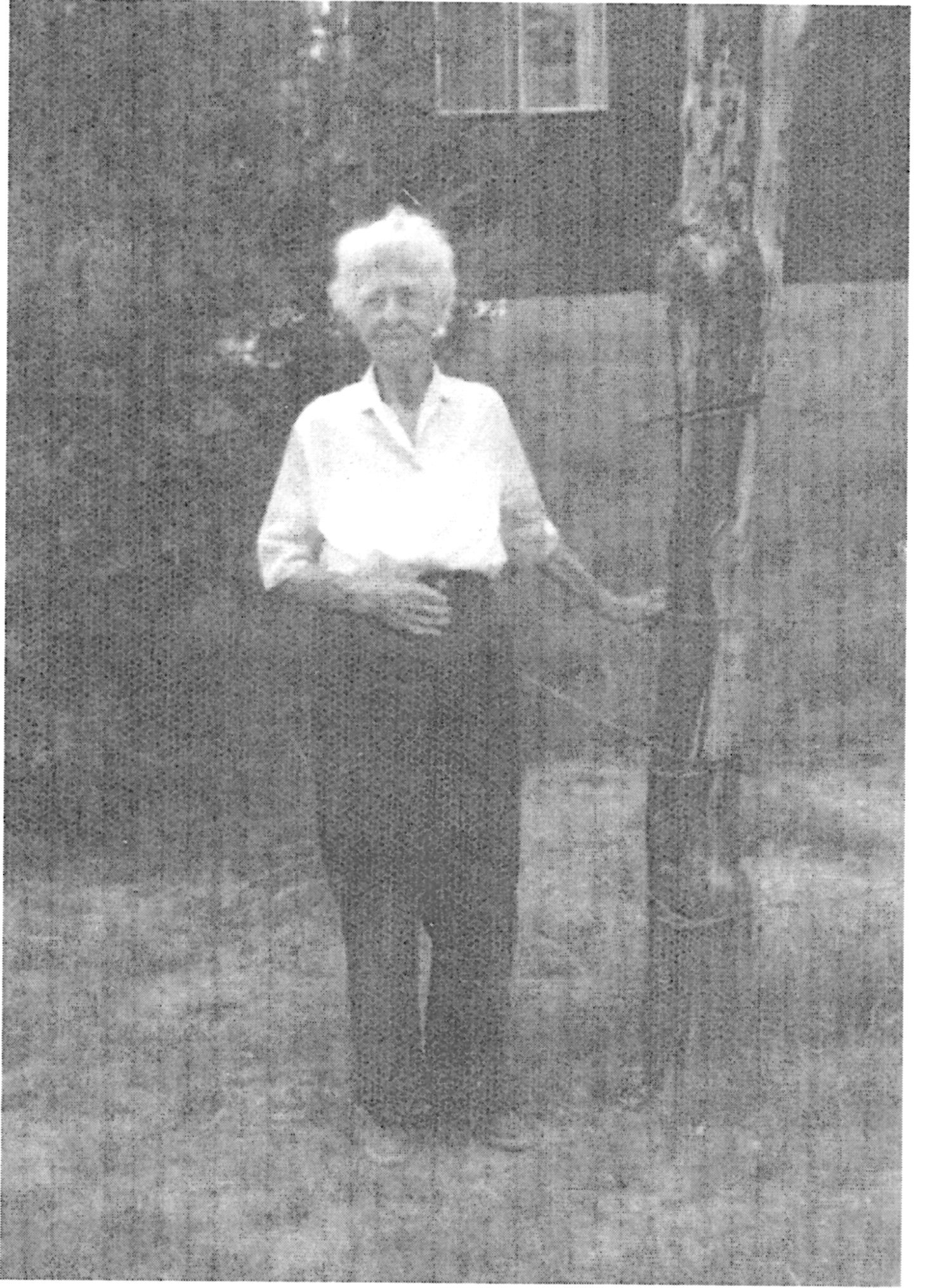
Cora E. Greenlee Everhart


photo courtesy Bowman Archives Center

b. January 18, 1883 Wayne, Iowa
d. December 12, 1979 Nogales, Arizona

 During Cora's early years, she and her parents and siblings moved often and lived in small communities and mining camps in Kansas, Colorado, and Texas. She wasn't ever in one place for very long, and when she finally graduated from 8th grade, she was sixteen years old. She then had to take extra classes in order to graduate from high school and get a teaching certificate. It was an interesting start to a life engaged in teaching and education.

 She quickly found a job in a one-room school in Caddoa, Colorado. In 1906 she married Charles Everhart and they moved to Rawlins, Wyoming, where Charles had gotten a job as fireman for Union Pacific, shoveling coal. In three years, he was promoted to locomotive engineer, but they soon moved to Texas to help Charles' father with work on a farm he had bought. Money ran short, so Charles went west to find work, and Cora applied again to teach school.

 In Tucson, Charles was hired as a switch engineer on the Southern Pacific Railroad yard; Cora joined him. She remembered him blowing a switch engine whistle to celebrate Arizona statehood in 1912. She got an Arizona teaching certificate, spent a very short time under terrible working conditions in a one-room school, and soon moved to Elgin where Charles had filed for a 160-acre homestead. They lived in two tents which they converted to houses, complete with floors, windows, doors and a roof.

 In 1914, Cora resumed teaching, this time in the Vaughn district and in 1915, her son Jack was born. Some time around 1919, her younger sister, Marie, affected by polio, came to live with them. Cora left teaching, and in 1919 she became the Postmaster in Elgin. Shortly after, her sister Oscea moved to Tucson, and Marie went to live there. In 1924 Cora moved with Jack to Nogales where she became principal at the two-room Potrero School. From 1928 to 1942, she taught in Elgin, Vaughn, and Canelo, closer to her home where Charles lived. In addition to teaching, from 1932 to 1939 she was secretary of the Santa Cruz County Fair & Rodeo Association.

  Cora was involved in the creation of two ongoing Santa Cruz County institutions. In 1921, she and four other women created the Elgin Book Club, eventually expanding membership to seventeen women, to meet annually to discuss a book they had all passed around to read in the prior year. And she was one of fifteen women who in 1931 organized the Elgin Community Club; as its second president from 1932-33, she was instrumental in the initial construction of the clubhouse.

 In 1942 she was appointed to fill the unexpired term of the Superintendent of Schools of Santa Cruz County; she then was elected and re-elected to that position and she served for over 22 years. When she was first elected, she enrolled at the University of Arizona and earned her bachelor's degree; her granddaughter says Cora was more proud of that degree than any of her other accomplishments.

 In 1963, she was made an Honorary Life Member of the Primeria Alta Historical Society. She wrote a long and detailed account of the history of the Canelo area; it is part of the archives at the Bowman-Stradling History Center at the fairgrounds in Sonoita. She died at age 96, and remained active and interested in the world around her up until her death.

Adapted by Corbin Smith from chapter in "More Hidden Treasures of Santa Cruz County" by Betty Barr; and from artcles by Alison Bunting in the "Patagonia Regional Times".

Click below to return to:
History
A-D
E-H
I-P
Q-Z

SCS 8/10/26