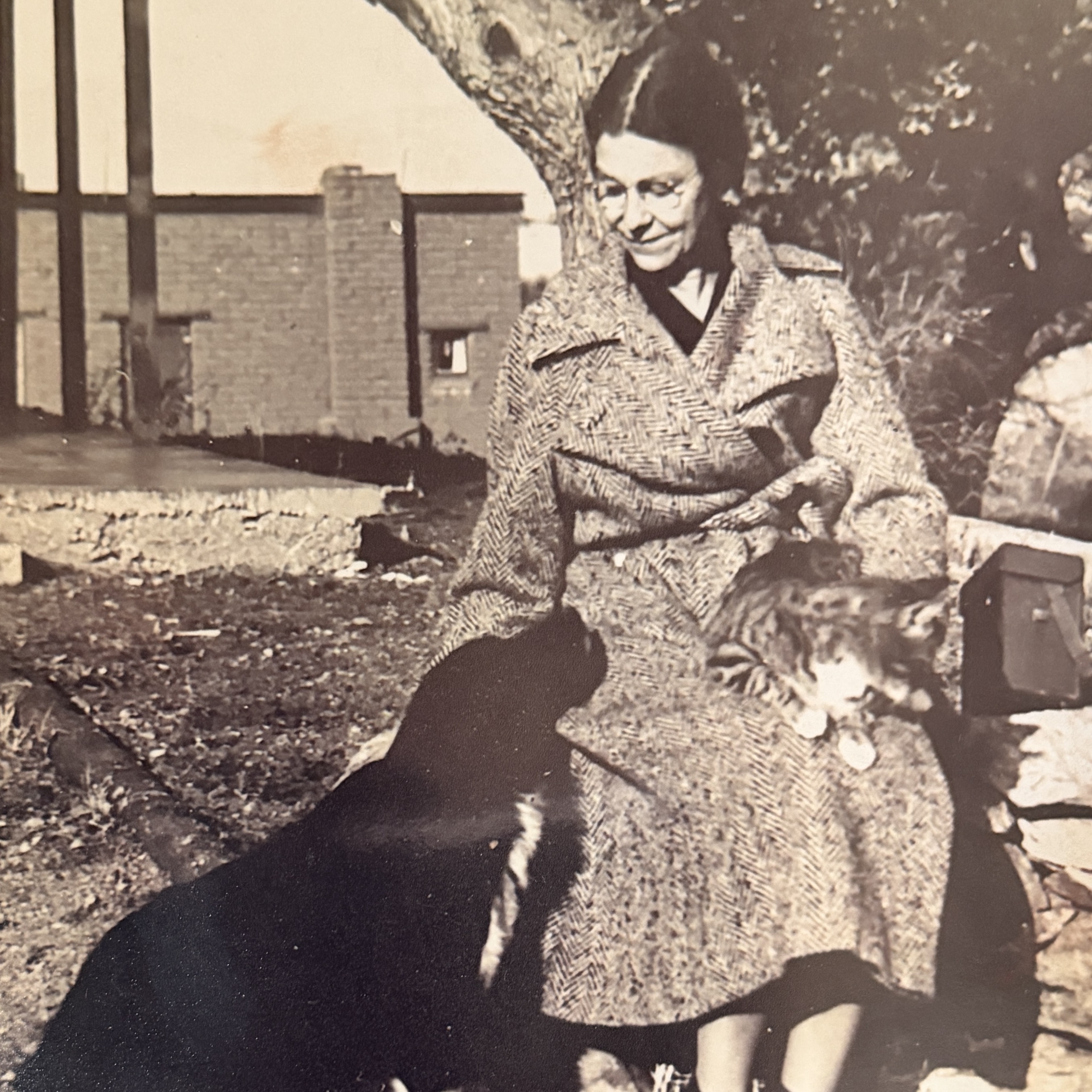
b. May 10, 1887 Fairhaven, Massachusetts
d. July 7, 1963 Tucson, Arizona
They were the first Anglo family in the area, and Fredric learned ranching from the Mexican ranchers who had already settled there. A Ph.D. dissertation by Robin Lothrop Pinto titled " Cattle Grazing in the National Parks: Historical Development and History of Management in Thee Southern Arizona Parks " from the University of Arizona School of Natural Resources and the Environment includes photos and extensive information about the family's history in part of what became Saguaro National Park. One of their ranches was known as the Rocking K.
Dorothy and Fredric Sr. divorced in 1929; they sold their X9 ranch to Rukin Jelks and moved to Tucson where he resumed his career as an architect. Dorothy engaged in her passion for archaeology and she collected artifacts in various areas around the city. She owned a number of acres of land in Tucson, and decided that a part of her property containing the remains of a Hohokam village was too valuable, from a scientific standpoint, to be owned privately. So in 1930 she deeded six acres of what she owned to the University of Arizona to be used for educational purposes. Soon after her donation and with assistance from the Tucson Chamber of Commerce, the University aquired an additional seven acres. The site is known as the University Indian Ruin; it is a Classic Period Hohokam archaeological site, dating to 1100-1400 which includes a platform mound and adobe compounds, one of the last platform mound communities still existing in the Tucson Basin. It is used for training archaeology students at the University, and it hosts visiting scholars in archaeology and anthropology.
Around 1936, she moved to Canelo where she took on an old adobe next to an oasis marsh (cienega) in the O'Donnell basin between the Huachuca and Patagonia mountains. It had been known as the O'Donnell place in the 1880s and prior to that, when it was a two room fortress, as Mr. Whitehead's.
She renovated it, with considerable help from Alex Gonzales, described by her grand-daughter as Dorothy's 'right hand man' (who is also buried at Black Oak), and with input from her husband and from her son Fredric Jr. it became her life's obsession. She had a few cows,a horse or two, and chickens, dogs,and cats. There was a shed in back to keep things cool in summer and warm in winter. Her grandkids would help press apples into cider and quince into membrillo, making the trip from Tucson to Canelo usually by car and sometimes by an old plane that belonged to Fredric Jr. whose daughter recalls having the job of throwing rocks off the landing strip.
In 1947 she donated to the Arizona Historical Society a small collection of miscellaneous documents and biographical materials including homestead claims and a record of the Knipe's brand registration.
When she died her house was left to her family, and it was purchased from the family in 1969 by the Nature Conservancy; it became the Canelo Hills Cienega Reserve, and the area was designated as a National Natural Landmark in December 1974.
One local resident remembers Dorothy as a lovely lady with her long hair braided and wrapped round and round her head in a coronet. Dorothy is the second in her family to be buried at Black Oak after her daughter Louise Knipe 'Winty' Thomas.
written by Corbin Smith from contributions from Dorothy's granddaughter Mary Knipe Verplank, from the dissertation mentioned above, and from other historical sources.
Click below to return to:
History
A-D
E-H
I-P
Q-Z
SCS 3/30/26